

Free Electronic Components for Student Projects: How Singapore Students Can Get Hardware for STEM and AI Builds
Singapore students can get free or low cost electronic components through three main routes: school and polytechnic makerspaces, community makerspaces with free youth membership, and component suppliers that run education programmes, such as Win Source, which has provided free components to engineering students for many years. Combining these routes means a student can prototype a real STEM or AI project without a large budget.
Hardware is often the hardest part of a student project. Code is free to write, but sensors, microcontrollers and boards cost money, and a single broken part can stall a build for weeks. This guide is for students, parents and teachers who want to know where to find parts, what a first AI project actually needs, and how to make a small budget go further.
Why Does Hands On Hardware Matter for STEM and AI Learning?
Hands on hardware matters because it turns abstract concepts into something students can test, break and fix. Writing an AI model on a laptop teaches coding. Making that model react to a real sensor teaches engineering: power, timing, noise, and the gap between what works in theory and what works on a desk.
Singapore schools already lean into this. Design and Technology programmes at secondary level, for example, now include learning journeys to professional makerspaces alongside design and make projects. Many primary and secondary schools also run their own tinkering spaces.
The challenge comes when a student wants to go further than the class kit: a competition entry, a CCA project, a personal AI build, or a final year project at polytechnic or university. That is when knowing where to find parts becomes as important as knowing how to use them.
Where Can Singapore Students Get Free or Low Cost Components?
The best option depends on the student’s age and school. Younger students do well in community makerspaces, while polytechnic and university students can tap campus facilities and supplier programmes.
| Option | Who it suits | What you get | Cost |
|---|---|---|---|
| School tinkering space or makerspace | Primary and secondary students | Class kits, basic tools, teacher guidance | Free through school |
| Vivistop Kampong Eunos | Ages 9 to 16 | Laser cutters, 3D printers, tools and daily maker sessions | Free membership for ages 9 to 16 |
| Singapore Polytechnic Makerspace @ Lib and Fab Lab | SP students, plus selected upper secondary programmes | DIY kits, electronics workstations, workshops | Access through the polytechnic |
| NUS CDE maker spaces and Makers Interest Group | NUS College of Design and Engineering students | Prototyping facilities, electronics workshops, credits for prototyping projects | Access through the faculty |
| Supplier education programmes such as Win Source | Engineering students working on real projects | Free electronic components for qualifying projects | Free, subject to the supplier’s terms |
A practical approach is to combine them: use a makerspace for tools and guidance, then request specific parts from a supplier programme when the project needs components the kit does not include.
How Does a Supplier Programme Like Win Source’s Work?
WIN SOURCE, a global electronic components distributor that specializes in hard to find and obsolete parts, runs Win Source’s free components program for engineering students as part of its support for engineering education. According to a 2022 company announcement, the practice of giving free components to engineering students had already been running for more than 18 years, alongside free technical support for makers.
The company’s education support goes beyond components. In 2026 it sponsored Formula Bharat, a student engineering competition in India, and it has also funded a scholarship at RWTH Aachen University in Germany.
Eligibility and the application process are set by the company and can change, so check the programme page for current terms. Whatever the supplier, a request is stronger when it includes:
- A short project description. What you are building, why, and who it helps.
- A clear parts list. Exact part numbers and quantities, not just “some sensors”.
- Your school or institution details. Plus a teacher, lecturer or supervisor who can confirm the project.
- A plan to share results. A write up, demo video or competition entry shows the parts will be put to real use.
Supplier programmes work best for specific components a project needs, such as a particular microcontroller, sensor or power part, rather than general starter kits.
What Are Good Starter AI Projects and What Parts Do They Need?
Good starter AI projects use one sensor, one small model and one clear output. These five ideas run on low cost hardware and teach the core skills of edge AI: collecting data, training a model and running it on a device.
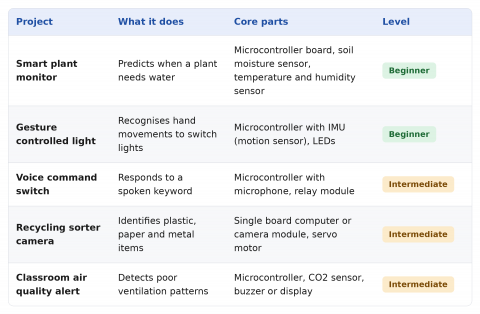
Start with the smallest version that works, then add features. A plant monitor that lights an LED is a finished project. One that also sends alerts to a phone is a stronger second version, and a great story for a portfolio or school application.
Frequently Asked Questions
Where can students get free electronic components in Singapore? Students can use school makerspaces, community makerspaces such as Vivistop, which offers free membership for ages 9 to 16, campus facilities at polytechnics and universities, and supplier education programmes such as Win Source’s free components program for engineering students.
Are there free makerspaces for kids in Singapore? Yes. Vivistop Kampong Eunos offers free membership for children aged 9 to 16, with access to tools such as laser cutters and 3D printers and daily maker sessions.
What hardware does a beginner AI project need? Most beginner AI projects need a microcontroller board, one sensor such as a microphone, camera or motion sensor, and a simple output such as an LED, buzzer or motor.
How do I ask a company for free components for a school project? Send a short project description, an exact parts list with quantities, your school details with a supervising teacher, and a plan to share the results. Check the company’s programme page for its current eligibility rules.
Can secondary school students do AI projects? Yes. Projects like a smart plant monitor or gesture controlled light use simple models and low cost parts, and are well within reach of motivated secondary students.
Sources
- Win Source Reaffirmed as a Value Component Supplier, Embedded Computing Design (November 2022)
- Win Source sponsors Formula Bharat 2026, Formula Bharat
- WIN SOURCE Provides Scholarship Support at RWTH Aachen University, Machine Design
- Vivistop Kampong Eunos: Maker Space With Free Membership For Children, Little Day Out
- Makerspace @ Lib and Fab Lab, Singapore Polytechnic
- Maker-in-Residence and Makers Interest Group, NUS College of Design and Engineering
- Design and Technology, Singapore MOE school programme page



Give your Opinions