

If you have a toddler at home, chances are someone has already told you: “Start Mandarin early.” And they’re not wrong. The window between 18 months and 3 years old is one of the most powerful periods for language acquisition — a time when young brains are wired to absorb sounds, rhythms, and patterns with remarkable ease. For Singapore parents navigating a bilingual landscape where English often dominates the home, finding the right Mandarin immersion programme for a toddler can feel overwhelming.
Should you choose a full-immersion preschool or a weekly enrichment playgroup? Does your child need to hear Mandarin at home for immersion to work? How much Mandarin is enough at this age? This guide answers all of these questions. We’ve rounded up the best Mandarin immersion programmes for toddlers in Singapore — covering full-immersion preschools, strong bilingual childcare centres, and dedicated enrichment playgroups — so you can make a confident, well-informed choice for your little one.
Why Start Mandarin Immersion in the Toddler Years?
The science behind early language learning is compelling. Children are born with the neurological capacity to process all human language sound patterns, and research consistently shows that the best window for acquiring any language — especially a tonal one like Mandarin — is from birth to around six years old. During this period, children absorb new sounds and intonation patterns far more naturally than older learners. Starting Mandarin immersion as a toddler means your child builds an intuitive feel for the language’s tones, rhythm, and cadence, rather than having to consciously decode them later.
Beyond language itself, there are meaningful cognitive benefits. Bilingual children in immersion programmes tend to show improvements in executive functioning — including stronger working memory, the ability to sustain attention, and better mental flexibility. Mandarin’s unique tonal complexity and character-based script also challenge the brain in ways that can strengthen analytical thinking and memory. In Singapore’s context, the advantages are especially practical: Mandarin is a core component of the primary school curriculum, and children who enter Primary 1 with an early immersion foundation are far better prepared for what lies ahead.
There is also a cultural dimension that is easy to overlook. Toddlers immersed in Mandarin don’t just learn vocabulary — they absorb the stories, songs, festivals, and traditions woven into Chinese language and culture. This early cultural familiarity fosters a genuine affinity for the language that makes ongoing learning feel natural rather than forced. Even for English-dominant households, a well-structured immersion programme can create a meaningful Mandarin environment that home life alone often cannot provide.
Full Immersion vs. Bilingual: What’s the Difference?
Before diving into specific programmes, it helps to understand the two main models you’ll encounter in Singapore’s toddler education space. A full Mandarin immersion programme delivers the entire curriculum in Mandarin. English may be introduced gradually at certain stages, but the classroom environment is overwhelmingly Chinese-speaking. This model maximises language exposure and is particularly beneficial for children from non-Mandarin-speaking homes who won’t hear much of the language otherwise.
A bilingual (50:50) model, on the other hand, uses both English and Mandarin across the day — often with dedicated English and Mandarin teachers co-teaching the same class. This approach develops both languages simultaneously and is a popular choice for parents who want strong bilingual foundations without exclusively prioritising one language. There are also Mandarin enrichment playgroups, which are standalone weekly classes that complement a child’s existing preschool or childcare routine, offering focused Mandarin exposure in a play-based setting. Each model serves a different family need, and the right choice depends on your child’s age, current language environment, and how much daily Mandarin contact you want them to have.
Full Mandarin Immersion Preschools for Toddlers
These preschools deliver the majority or entirety of their curriculum in Mandarin, creating a rich, consistent Chinese-language environment from a young age. Most accept children from as young as 18 months or even earlier through infant care programmes.
EtonHouse Pre-School — ZhongHua Full Mandarin Immersion
EtonHouse’s ZhongHua Full Mandarin Immersion Programme is one of the most well-regarded options in Singapore and is available across several of its pre-school campuses, including the City Pre-School, Vanda, Newton, and Upper Bukit Timah. The programme is designed for children from 18 months to 6 years old and operates through EtonHouse’s signature Inquire.Think.Learn curriculum, delivered entirely in Mandarin. Children are immersed in the language across all subjects — science, mathematics, arts, and everyday routines — making Mandarin a living, purposeful part of their daily experience rather than a standalone lesson.
What sets ZhongHua apart is its inclusion of rich Chinese cultural content. Calligraphy, Chinese performing arts, and inquiry projects on traditional Chinese customs are woven into the curriculum, helping children develop not just fluency but genuine cultural appreciation. EtonHouse also offers a China Immersion Programme for children aged 3 to 8, where families can opt for their child to experience learning at an EtonHouse school in China or join cultural excursions to cities like Suzhou, Chengdu, or Beijing — an exceptional opportunity for deepening immersion beyond the classroom.
- Age range: 18 months to 6 years (infant care also available)
- Locations: Multiple campuses including City Pre-School, Vanda, Newton, Upper Bukit Timah
- Website:www.etonhouse.edu.sg
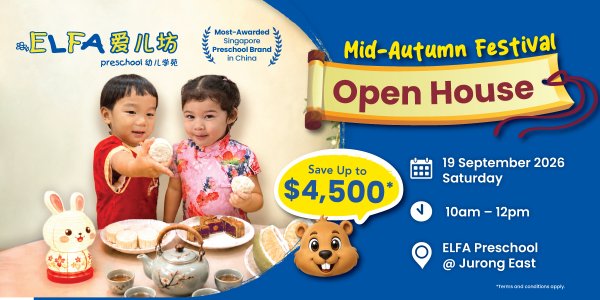
ELFA Preschool
ELFA Preschool has been one of Singapore’s most dedicated Mandarin-immersive childcare providers since 2000, with a network spanning more than 20 centres across Singapore and China. What distinguishes ELFA is that its Mandarin programme begins in infancy — children from as young as two months are introduced to the language through stories, songs, and gentle daily routines, capitalising on the earliest months of brain development. This early, sustained exposure is designed to build native-like pronunciation and intonation that children who start later often struggle to replicate.
The curriculum is built around an integrated thematic story-based methodology, co-developed by Singapore early childhood specialists and Chinese education advisors from Beijing Normal University. Mandarin is used as the medium of instruction across creative art, Chinese speech and drama, and higher-order thinking mathematics — embedding the language naturally into every part of the school day. ELFA’s approach pays off measurably: 100% of its K2 graduates have passed the Youth Chinese Test (YCT) Level II, an internationally recognised benchmark aligned with the HSK framework. Three Singapore locations serve families across Jurong East, Hougang, and Tampines.
- Age range: 2 months to 6 years
- Locations: Jurong East, Hougang, Tampines
- Website:www.elfapreschools.com
Mulberry Learning (Chinese Preschool)
Mulberry Learning is best known as a Reggio Emilia-inspired preschool group, but its dedicated Chinese Preschool offering — particularly the Fusionopolis campus — takes immersion to a higher level. Unlike Mulberry’s standard bilingual preschool which balances English and Mandarin equally, the Chinese Preschool emphasises approximately 80% Mandarin in the early years, targeting exposure to over 3,000 Chinese vocabulary words, 35 poems, and 90 idioms by the time children transition to primary school. The Reggio framework means children are active investigators in their own learning, engaging with language through open-ended projects, storytelling, and real-world exploration rather than rote repetition.
Mulberry’s signature Chinese Master programme incorporates traditional Chinese poetry, calligraphy, idioms, Chinese festivals, and Confucian values through Di Zi Gui (弟子規), giving children a culturally rich immersive context. The programme is crafted by educators with more than 30 years of early childhood experience and is available across 19 locations islandwide — an important practical advantage for busy Singapore families.
- Age range: 2 to 17 months (infant care); 18 months and above (preschool)
- Locations: 19 locations across Singapore
- Website:www.mulberrylearning.com
Little Paddington Preschool
Little Paddington Preschool at Bartley offers a dedicated Mandarin Immersion Programme that follows the MOE syllabus, making it a natural bridge between early immersion and formal primary school expectations. The school’s approach integrates interactive, inquiry-led learning with consistent Mandarin immersion, so children build vocabulary and comprehension through discovery and play rather than passive repetition. Little Paddington is also well regarded for its dedicated primary school preparation focus and its strong emphasis on social-emotional development, ensuring children don’t just become more fluent — they also grow in confidence and independence. This makes it a particularly thoughtful choice for parents who want Mandarin immersion alongside holistic early childhood nurturing.
- Age range: Playgroup to Kindergarten 2
- Location: 9 Upper Paya Lebar Road, Singapore
- Website:www.littlepaddington.com
Odyssey – The Global Preschool
Odyssey – The Global Preschool takes a Reggio Emilia-inspired approach and offers a Chinese Immersion curriculum that places equal emphasis on Mandarin as a first language alongside English. Children are guided through inquiry-based learning experiences where Chinese is not merely taught but actively used to question, discuss, create, and collaborate. With a low child-to-teacher ratio, every child benefits from personalised attention, which is especially valuable for toddlers at the very beginning of their Mandarin journey. Odyssey’s philosophy — that children explore the world through their own eyes — means language is always learned in rich, meaningful context.
- Age range: 18 months to 6 years
- Locations: Multiple locations across Singapore
- Website:www.odyssey.edu.sg
Strong Bilingual Mandarin-English Preschools
For families who want rigorous Mandarin immersion without a fully Chinese-only environment, these preschools offer structured bilingual programmes that give toddlers daily, meaningful Mandarin contact within an English-inclusive setting.
Raffles Kidz International
Raffles Kidz International offers a carefully balanced 50:50 Mandarin and English immersion model, with both English and Mandarin teachers present in every classroom throughout the day. Rather than separating language into distinct lesson blocks, both languages are applied naturally across all activities — conversations, hands-on projects, roleplay, and collaborative play. The programme draws on Montessori and inquiry-based principles, which aligns well with how toddlers learn best: through self-directed exploration and multi-sensory engagement rather than structured drills. Ideally starting between 18 months and 3 years, children benefit from this approach when the brain is at its most receptive to language acquisition.
Raffles Kidz also includes enrichment classes such as Chinese Speech and Drama and Creative Arts within its core curriculum at no additional cost, giving toddlers extra daily touchpoints with the language. The result is a confident bilingual environment where children naturally switch between languages and develop fluency in both — a real advantage heading into Singapore’s bilingual primary school system.
- Age range: Infant care and above (from 18 months for bilingual programme)
- Locations: Multiple locations across Singapore
- Website:www.raffleskidz.com
House on the Hill Montessori Preschool
House on the Hill takes a Montessori approach to Mandarin immersion, assigning a native-speaking laoshi (teacher) to each class who integrates Mandarin naturally throughout daily routines — during greetings, snack time, play, and learning activities. Rather than pulling children out for formal Mandarin lessons, the language is embedded into the Montessori environment so toddlers encounter it repeatedly in everyday contexts. The programme covers listening, speaking, reading, and early writing through stories, songs, books, poetry, and hands-on activities, making language acquisition feel organic.
For families wanting deeper immersion, House on the Hill also offers 天天向上 (Tian Tian Xiang Shang), an elective afternoon programme conducted entirely in a Chinese-speaking environment, with additional cultural activities. Available across campuses in Mount Sophia, Balmoral, Hollandse Club, and Pasir Panjang, this is a strong option for families in central Singapore who value Montessori philosophy combined with genuine Mandarin presence.
- Age range: 18 months to 6 years
- Locations: Mount Sophia, Balmoral, Hollandse Club, Pasir Panjang
- Website:www.houseonthehill.com.sg
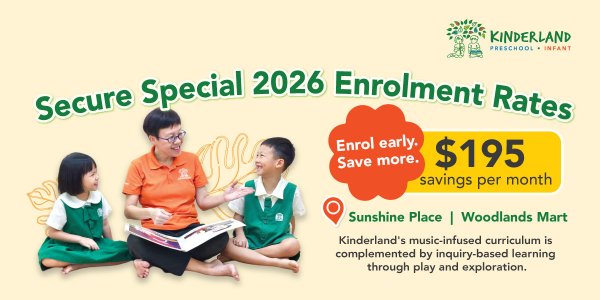
Kinderland
Kinderland stands out for its music-infused bilingual approach, using songs, rhythm, and movement as core vehicles for both English and Mandarin language development. For toddlers, this is especially effective: music and repetition strengthen memory retention and help young children internalise pronunciation and vocabulary in a way that feels joyful rather than academic. The curriculum follows a progressive structure — younger children are introduced to both languages through songs, guided interaction, and visual cues, while Nursery and Kindergarten-level children gradually expand vocabulary and begin forming simple sentences through classroom conversation.
The bilingual learning is woven into daily routines including play, storytelling, and thematic activities, so children encounter Mandarin and English in authentic, connected contexts. With a large network of centres across Singapore — including Yio Chu Kang, Marine Parade, Hougang, and the Holland area — Kinderland is a widely accessible choice for families across the island.
- Age range: Infant care and above
- Locations: Multiple locations islandwide
- Website:www.kinderland.com.sg
Little Skool-House
Little Skool-House is a consistently award-winning preschool brand with a proven bilingual English-Mandarin curriculum and a strong track record in primary school preparation. Its SPARK-certified centres use structured immersion learning that develops bilingual competency progressively from infant care through Kindergarten 2. A key strength is its network of centres located within corporate and institutional campuses, making it an especially practical option for working parents who need quality bilingual childcare close to their workplace. The school’s award-winning teachers and diverse enrichment programmes in arts, STEM, and sports ensure that language learning is always embedded within a rich, holistic educational experience.
- Age range: Infant care to Kindergarten 2
- Locations: Multiple centres across Singapore (including corporate campus centres)
- Website:www.littleskoolhouse.com.sg
The Schoolhouse by Busy Bees
The Schoolhouse by Busy Bees blends its five-pillar curriculum — which emphasises 21st-century skills, inquisitive learning, and bilingual learning methods — with a thoughtful Mandarin immersion structure. Its bilingual programme integrates both Mandarin and English across daily activities including storytelling, music, numeracy, and themed projects, so children develop confident bilingual communication skills in authentic, connected settings. The school’s Theatre House programme, which uses a dual in-class educator approach, ensures children are continuously immersed in a bilingual environment while also developing in areas like creative expression, confidence, and collaboration. Cultural enrichment through traditional Chinese art, festive celebrations, and interactive storytelling deepens children’s connection to the Mandarin language beyond mere vocabulary.
- Age range: Infant care and above
- Locations: Multiple locations across Singapore
- Website:www.theschoolhouse.com.sg
Mandarin Enrichment Playgroups and Classes for Toddlers
Not every family is ready to switch preschools — and that’s completely valid. Dedicated Mandarin enrichment playgroups are a flexible, low-commitment way to significantly increase your toddler’s Mandarin exposure alongside their existing childcare arrangement. These weekly classes are specifically designed for very young children, combining music, movement, storytelling, and sensory play in an all-Mandarin setting. Many are also parent-accompanied, which makes them especially reassuring for toddlers who are not yet in full-time childcare.
Chengzhu Mandarin Centre
Chengzhu Mandarin Centre — the dedicated Mandarin arm of Julia Gabriel Education — has been nurturing young Mandarin learners since 2012. Its PlayClub programme for toddlers introduces children to key Mandarin concepts through stories, puppets, drama activities, art and craft, songs, and even healthy snacks, all in a structured yet playful environment. The centre’s signature EduDrama methodology uses drama and storytelling as its core teaching tools, making language acquisition inherently active and engaging. Sessions stimulate the imagination and develop the foundations for speaking and thinking in Mandarin, while music and rhythmic movement help children appreciate the natural sounds and cadence of the language.
What makes Chengzhu particularly appealing for toddler families is its seamless progression — children who begin with PlayClub can continue through the centre’s programme all the way to Primary 6, building a consistent relationship with the language and with their teachers over many years. Four centres at Rochester Mall, Greenwich V, Woodleigh Mall, and Marina at Keppel Bay serve families across different parts of Singapore.
- Age range: 6 months to 12 years (PlayClub for toddlers)
- Locations: Rochester Mall, Greenwich V, Woodleigh Mall, Marina at Keppel Bay
- Website:www.chengzhu.edu.sg
EduGrove Mandarin Enrichment Centre
EduGrove’s Mandarin PlayGrove programme is one of Singapore’s most active toddler Mandarin playgroups, welcoming children from as young as one year old into an all-Mandarin environment. The programme is explicitly designed to nurture the whole child — every activity, from songs and storytelling to interactive games and sensory play, develops cognitive, social, and motor skills alongside Mandarin language acquisition. EduGrove’s curriculum uses specially composed songs where rhythm, rhyme, and vocabulary repetition help toddlers naturally absorb Mandarin phonics and keywords. The class structure is multi-stationed, allowing each child to explore different developmental areas at their own pace while teachers provide individual support.
A particularly practical feature of EduGrove’s toddler programme is that it is designed as a parent-accompanied class, making it accessible and reassuring for very young children who are not yet in preschool. The PlayGrove programme also serves as a gentle preparation for drop-off classes, helping toddlers develop familiarity with a classroom routine and reducing separation anxiety when it’s time for preschool. EduGrove operates from a wide network of centres including Pasir Ris, East Coast Road, Our Tampines Hub, AMK Hub, Harbourfront Centre, SAFRA Choa Chu Kang, Woodleigh Mall, and Anchorvale Village.
- Age range: 7 months to Secondary 4 (PlayGrove for toddlers from 1 year old)
- Locations: Multiple locations island-wide
- Website:www.edugrove.com.sg
Huá Language Centre
Huá’s Chinese Playgroup is a thoughtfully designed enrichment programme for toddlers aged 1 to 3 years, combining Mandarin immersion with developmental milestones to ensure children grow holistically while absorbing the language. The programme uses stories, music, play, and hands-on activities to develop early listening skills and natural speech mimicry, with small class sizes — capped at six toddlers — ensuring each child gets plenty of speaking time and personalised attention from the teacher. The intimate setting creates a warm, responsive environment where language use feels natural and enjoyable, rather than pressured.
Huá also stands out for its emphasis on parent involvement and continuity of learning beyond class time. Every child receives activity kits including storybooks, word cards, and songs accessible via QR codes, so families can reinforce Mandarin at home in organic, everyday moments. Parent-child bonding activities are also integrated into sessions, creating a shared Mandarin experience that strengthens both family connection and language retention.
- Age range: 1 to 3 years (Chinese Playgroup); broader programmes available for older children
- Locations: Multiple centres across Singapore
- Website:hua.com.sg
How to Choose the Right Mandarin Immersion Programme for Your Toddler
Every toddler’s situation is different, and the right programme depends on a combination of your child’s temperament, your family’s language environment, your schedule, and your long-term goals. Here are the key questions to ask yourself before making a decision:
- How much Mandarin does your child currently hear? If your household is primarily English-speaking, a full-immersion preschool or daily bilingual childcare will compensate for the lack of home exposure far more effectively than a once-a-week enrichment class alone.
- What is your child’s age and readiness? Enrichment playgroups like those at Chengzhu, EduGrove, and Huá are specifically designed for children from 6 months to 3 years and are often parent-accompanied — ideal for very young toddlers not yet in full-time care. Full immersion preschools typically accept children from 18 months onwards.
- What teaching philosophy matters to you? Some families are drawn to Montessori-aligned programmes (House on the Hill, Raffles Kidz), others prefer Reggio Emilia-inspired learning (Mulberry Learning, Odyssey), and others value a structured story-based approach (ELFA, Chengzhu). Match the pedagogy to how your child learns best.
- How important is location and convenience? Singapore’s MRT network makes location a major practical consideration. Choosing a programme close to home, your workplace, or a convenient MRT station will help you maintain consistency — which is crucial for language development.
- Are you looking for enrichment or full childcare? If you need full-day childcare, look at preschools with integrated Mandarin immersion. If your child is already in a preschool you love, adding a dedicated Mandarin enrichment class a few times a week can meaningfully supplement their language exposure.
If possible, visit shortlisted centres before committing. Observe how teachers interact with the toddlers in Mandarin — whether the language is genuinely woven through play and routines, or confined to a short lesson block. The quality of Mandarin immersion is less about the name on the door and more about the daily lived language experience your child will have.
Find Mandarin Immersion Programmes Near You
Location plays a crucial role in sustaining any enrichment or preschool commitment for busy families. Skoolopedia makes it easy to search for preschools near MRT stations across Singapore, so you can filter by your nearest station or neighbourhood and find quality Mandarin immersion options that are genuinely convenient for your daily routine. You can also browse enrichment centres near MRT stations to discover Mandarin playgroup classes close to home or work.
If your child is approaching primary school age, Skoolopedia’s student care directory also helps you plan ahead for after-school care options that continue to support your child’s bilingual development. For trusted recommendations from fellow Singapore parents, check out the Skoolopedia Parents’ Choices Award, which recognises the programmes that families across Singapore consistently rate most highly.
The Best Time to Start is Now
Whether you choose a full-immersion preschool, a strong bilingual childcare centre, or a dedicated Mandarin enrichment playgroup, the most important factor is consistency. Toddlers who receive regular, meaningful Mandarin exposure — through play, music, stories, and daily conversation — build a genuine foundation that grows with them through primary school and beyond. The programmes listed in this guide represent some of the most purposeful and well-regarded Mandarin immersion options Singapore has to offer for the very youngest learners.
Start by identifying what your child needs most — more daily immersion, cultural depth, a play-based environment, or flexible scheduling — and let that guide you to the right fit. And if you are still exploring, Skoolopedia’s searchable directory can help you narrow down options by location, age group, and programme type, so the search feels a little less overwhelming and a lot more manageable.
Ready to Find the Right Programme?
Skoolopedia is Singapore’s most comprehensive education portal for parents. Search preschools, enrichment centres, and childcare options by MRT station or neighbourhood — and access crowdsourced reviews, open house listings, and expert Q&As to help you make the best decision for your child.
Give your Opinions